Salesforce AIforce, formerly Headless 360, lets work in your CRM happen without anyone opening it. The same data, rules, and approvals can be reached from a messaging thread, a phone conversation, a field app, a customer portal, or an AI agent.
Your team keeps the screens they use today. Nothing is being taken away. What changes is how many other places that same logic can show up.
The cost it removes is one you are already paying. Most organizations maintain the same pricing, eligibility, and approval rules in several systems at once, and pay to keep each copy current.
What automation cannot reach, people copy. Those copies drift, and customers get answers that no longer match what your system says.
It starts with one process, not with the platform. A single process with a measure attached is what proves the case and funds the next one.
TEST
For years, “quote-to-cash” defined the standard process: configure, price, quote, and bill. But in today’s world of complex subscriptions, hybrid pricing, and real-time financial compliance, that model is showing cracks.Enter Salesforce Agentforce Revenue Management, the evolution of Revenue Cloud Advanced/Revenue Lifecycle Management — a re-architected, AI-driven platform that doesn’t just patch the old process, but redefines it. Built on Salesforce’s Agentforce platform, revenue processes are no longer just automated, they are increasingly agent-assisted and policy-driven, reducing manual intervention across sales, finance and operations.The new standard is Product-to-Cash: a lifecycle where product definition, selling, billing, payments, and revenue recognition are unified on one platform.For RevOps, finance, and sales leaders, this isn’t a minor update. It’s the next era of revenue management.
Why Quote-to-Cash No Longer Fits Modern Revenue Models
The revenue lifecycle has evolved beyond the traditional quote-to-cash model. Businesses today need to move faster, support more complex product mixes, and unify the full customer and financial journey in a single platform. Business today also need systems that can reason, enforce policy and adapt in real time, not just execute static workflows. Agentforce Revenue Management is designed to deliver exactly that — a modern, AI-driven, end-to-end product-to-cash solution.Unlike the legacy Salesforce CPQ + Billing package, which centered mainly on sales-driven quoting and downstream invoice generation, the new Agentforce Revenue Management platform expands scope and capability. It aligns product definition, selling models, ordering, billing, payments, and revenue recognition into one lifecycle — ensuring finance, sales, and operations run seamlessly together.
The Shift from Sales-Centric to Product and Policy-Centric Revenue
Quote-to-Cash focused primarily on the sales process: configure products, create a quote, generate an order, and hand off to billing. While valuable, it often left gaps when products changed rapidly, when finance needed better visibility, or when businesses launched usage-based and recurring offerings.Product-to-Cash broadens this paradigm:
Product-first: Every SKU, subscription, usage metric, and bundle is defined once in a centralized catalog. Pricing, discounting, and entitlements flow from this source of truth.
Lifecycle-centric: Changes over time — amendments, renewals, suspensions, multi-year ramps — are treated as natural lifecycle events, not exceptions.
Finance-aligned: Revenue recognition, subledger entries, and compliance schedules are generated natively, avoiding mismatches between sales data and financial reporting.
Customer-embedded: Customers see accurate invoices, usage data, and balances directly in portals or agent-assisted channels, with payments seamlessly applied.
Policy-driven: Pricing rules, revenue treatment, invoicing logic and compliance policies are enforced consistently by the platform, not re-implemented across teams or systems.
In short, Product-to-Cash connects the catalog → quote → order → invoice → payment → revenue recognition cycle into one unified system.
Inside Salesforce’s New Revenue Engine
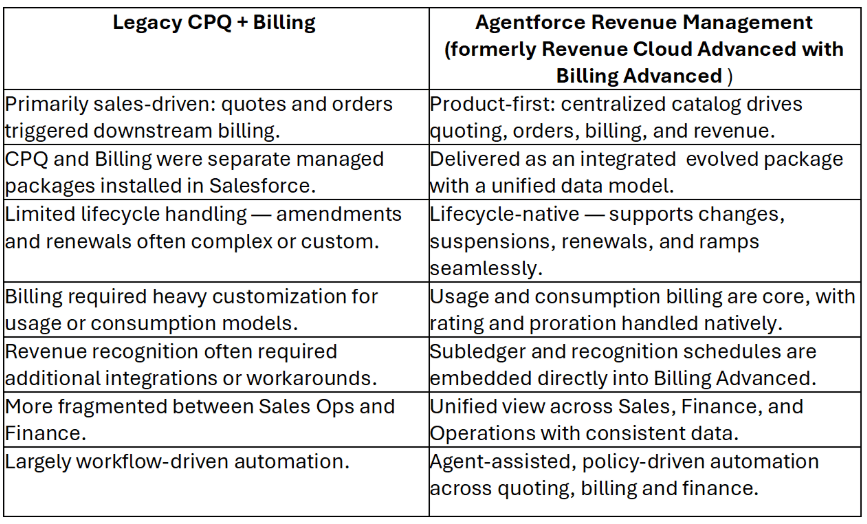
Agentforce Revenue Management combines a unified revenue data model with agent-assisted automation across the full product-to-cash lifecycle.Unified Product CatalogProducts, bundles, pricing models, and usage rules are defined centrally. This eliminates redundancy between sales and finance systems.Flexible Selling ModelsSupports one-time, subscription, consumption/usage, and hybrid models natively — with proration, tiering, and ramping logic embedded.Lifecycle ManagementHandles amendments, renewals, suspensions, and partial cancellations as first-class processes rather than exceptions.Advanced Billing AutomationInvoices can be generated on schedules, usage thresholds, or triggered events. Credit memos, adjustments, and collections are built in.Payments & CollectionsIntegrates with payment gateways, manages retries and dunning, and applies payments at the line-item level.Revenue Recognition & SubledgerAutomatically generates recognition schedules (ASC 606/IFRS 15 compliant) and posts journal entries, acting as a subledger for finance teams.Multi-Entity & Global ComplianceSupports multiple legal entities, tax jurisdictions, and currencies — critical for global organizations.A comparison table outlining features of Legacy CPQ+ Billing versus Agentforce Revenue Management.The shift is not just in naming — it represents a fundamental re-architecture. Agentforce Revenue Management is built on core to scale with modern revenue models, unify teams around a single product and financial source of truth, and reduce dependency on external systems or heavy customization.
Why It Matters: The Business Impact
Faster Time-to-Revenue: Automated invoicing and recognition shorten the cycle from product launch to recognized revenue.
Operational Efficiency: Sales, Finance, and Customer Success work from one platform, reducing errors and manual reconciliation.
Future-Proof Flexibility: Native support for subscriptions, usage, and hybrid billing enables faster pivots to new business models.
Customer Transparency: Embedded invoicing, usage details, and payments improve trust and experience.
Reduced Revenue Leakage: Agent-assisted enforcement of pricing, billing and revenue policies minimizes manual overrides and downstream corrections.
The Unified Revenue Lifecycle: A New Era for Sales, Finance, and Ops
The era of siloed quote-to-cash is giving way to holistic product-to-cash. Agentforce Revenue Management reflects this shift: moving from separate sales and billing functions toward an integrated lifecycle platform that unifies product definition, customer transactions, billing, and finance.Organizations adopting this new model gain more than just efficiency,they gain the ability to launch modern revenue models quickly, ensure compliance, and provide customers with a seamless experience from purchase to payment.
Ready to Advance Your Revenue Model?
If you’re rethinking how your organization manages revenue — or exploring a shift to subscription, usage-based, or hybrid models — now is the time to act. OSF Digital helps global businesses embrace Salesforce’s new Product-to-Cash model by designing, implementing and scaling Agentforce Revenue Management for modern revenue operations. Talk to an OSF expert and see how you can accelerate your revenue transformation.
AuthorMarlena HijContent Lead at OSF DigitalMarlena Hij leads the content function at OSF Digital. She writes about Salesforce solutions and enterprise AI, with a focus on what it takes to move from decision to production, drawing on OSF Digital experts, delivery teams and customer programs. Before OSF Digital, she spent five years at Japan Tobacco International in commercial roles across Spain and Portugal, ending as Market Manager for Travel Retail with P&L ownership and a thirty-person field team, and four years at IBM Europe in marketing automation and campaign management.
AuthorSean CatlinGlobal Head of Strategy, OSF DigitalSean leads the company’s global strategic vision and cross-industry growth agenda. A seasoned business leader with deep roots in financial services, Sean specializes in unlocking enterprise value through digital transformation, go-to-market innovation, and ecosystem partnerships. During his time at Salesforce, Sean helped build some of the world’s largest and most strategic Salesforce customers—experience that now fuels his leadership at OSF Digital, where he spearheads some of the planet’s most ambitious AI-first transformations. With a proven track record of guiding complex, industry-wide change, he drives OSF’s long-term direction while helping clients reimagine what’s possible in an AI-first world.